.svg)

Auckland insulation specialists focused on doing the job right — from ceiling and underfloor insulation through to full upgrades and Healthy Homes compliance.
May 11, 2026
If your home feels cold, your heat pump is working overtime, or your ceiling insulation looks a bit thin, the first question is usually pretty simple:
Can we just top up what’s already there, or does the old insulation need to come out first?
The answer depends on the condition of the existing insulation.
Sometimes a top-up is a smart, cost-effective way to improve performance. Other times, adding new insulation over the top of old, damp, contaminated or badly installed material just hides the problem.
We see both situations in Auckland homes all the time.
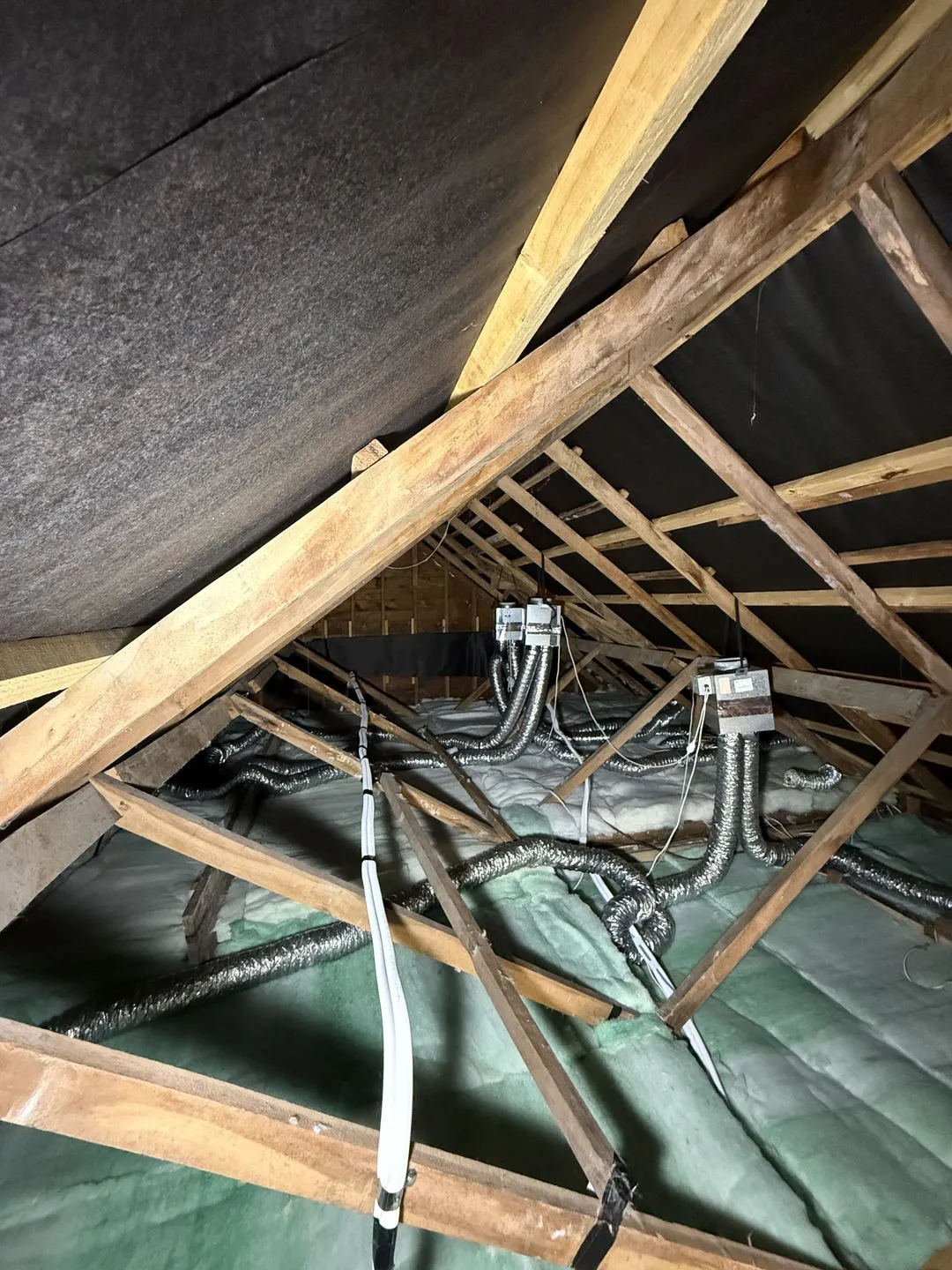
Some ceiling spaces are clean, dry and only need more coverage. Others have insulation that is patchy, compressed, dusty, damp, rodent affected, or moved around by previous electrical, plumbing or ventilation work.
So before deciding whether to top up or replace, the first step is working out what’s actually going on up there.
A ceiling insulation top-up is where new insulation is added over or around the existing insulation to improve the overall thermal performance.
This can be a good option when the existing insulation is still in reasonable condition but no longer provides enough coverage or thickness.
A lot of older homes already have some insulation in the ceiling. The issue is that it may have been installed years ago, to a lower standard, or with less coverage than you’d choose today.
If the existing insulation is still clean, dry, evenly laid and safe to work around, topping it up can often make sense.
A top-up may be suitable when the existing insulation is:
In these cases, the goal is not to remove perfectly usable insulation. It is to improve what is already there.
This can be especially useful in homes where the ceiling insulation is doing something, but not enough. You may still be losing too much heat through the roof, especially during winter, or the home may struggle to stay comfortable once the heating turns off.
A good top-up can help improve warmth, reduce heat loss and make the home easier to heat.
Replacement usually makes more sense when the existing insulation is no longer worth keeping.
That might be because it is damaged, unsafe, contaminated or simply not performing properly anymore.
Common reasons to replace ceiling insulation include:
In these situations, topping up over the old material is usually not the best answer.
It might make the ceiling look better from a distance, but the underlying problem is still there.
If old insulation is damp, smelly or full of rodent contamination, adding new insulation over it does not remove the smell, the mess or the hygiene issue. It just covers it.
This is one of the clearest cases where replacement is often the better option.
Rodents can cause a lot of damage in ceiling spaces. They can nest in insulation, tear it apart, leave droppings, urinate through it, and shift material around.
If the insulation has been contaminated, it may smell bad and may no longer be something you want sitting above your living space.
Common signs include:
A top-up will not fix rodent contamination. If the existing material is badly affected, removal and replacement is usually the cleaner and more sensible path.
Ceiling insulation needs to stay dry to work properly.
If it has been affected by a roof leak, condensation, poor ventilation or moisture entering the roof space, it can lose performance and become unpleasant to leave in place.
Damp insulation can also point to a bigger issue that needs to be dealt with first.
Before topping up, it is worth checking for:
If the insulation is wet or mouldy, the priority is not just adding more insulation. The moisture source needs to be understood first.
Otherwise, you may spend money on new insulation and still have an ongoing dampness problem.
Insulation works partly by trapping air.
When insulation becomes heavily compressed, it loses some of that ability. This can happen over time, or when people store items in the ceiling, walk over batts, move them around, or squash them during other work.
If the insulation is only lightly compressed in a few areas, it may be possible to tidy things up and top up.
But if large areas are flat, uneven or badly disturbed, replacement may be a better option.
A ceiling can be “insulated” but still have poor performance if the insulation is thin, compressed or full of gaps.
A lot of ceiling spaces look partly insulated but not properly insulated.
We often see gaps around:
These gaps matter.
Heat will find the weak points. You can have decent insulation across most of the ceiling, but if there are enough missing sections, the home may still feel cold and inefficient.
In some cases, a tidy-up and top-up is enough. In others, the existing insulation is so uneven that starting again gives a better result.
It is worth saying this clearly: old insulation does not always need to be removed.
Some older insulation is still clean, dry and doing a reasonable job. If it has not been affected by moisture, pests, major compression or poor installation, it may still be worth keeping.
In those cases, topping up can be the better use of money.
The question is not simply “how old is it?”
The better question is:
Is it still clean, dry, safe, complete and performing well enough?
If yes, a top-up may be fine.
If no, replacement may be smarter.
For rental properties, ceiling insulation also needs to be considered against the Healthy Homes insulation standards.
A property may have existing insulation, but if it is not thick enough, not in reasonable condition, or not installed properly, it may need attention.
For homeowners, the same logic still applies even if you are not dealing with rental compliance.
If the insulation is thin, patchy, damaged or below modern expectations, the home may be harder to heat than it should be.
A ceiling insulation top-up usually makes sense when:
Replacement usually makes sense when:
Sometimes the answer is also a mix.
One part of the ceiling may be fine to top up, while another section needs removal and replacement because of contamination, damage or access issues.
That is why an inspection is better than guessing.
When checking ceiling insulation, we are usually looking at:
The goal is not to sell replacement by default.
If a top-up makes sense, that may be the right recommendation. If the old insulation needs to come out, it is better to know that before adding anything new over it.
Neither option is automatically better.
A ceiling insulation top-up is better when the existing insulation is still in good enough condition to keep.
Full replacement is better when the existing insulation is damaged, damp, contaminated, badly compressed or no longer worth relying on.
The main thing is not to make the decision from the hallway looking up at the manhole.
Ceiling spaces can tell a very different story once someone actually gets up there and checks properly.
If your home is cold, hard to heat, or you’re unsure whether the ceiling insulation is doing its job, we can take a look.
We’ll check the condition of the existing insulation and let you know whether a top-up is enough, or whether replacement would be the better long-term option.
No scare tactics. Just a practical call based on what’s actually there.